

Is Your Insurance Print & Mail Disaster Recovery Plan Actually Ready?
Most insurance providers have a disaster recovery plan.
The more important question is: Will it actually work when you need it?
Severe weather, power outages, equipment failures, regional emergencies, and unexpected production disruptions can happen with little warning. For insurers producing time-sensitive policy documents, cancellation notices, nonrenewal notices, billing communications, and other regulated mail, simply waiting for operations to return to normal may not be an option.
Deadlines don’t disappear because your production facility is unavailable.
A strong disaster recovery strategy needs to do more than protect data. It needs to provide a practical way to continue producing and mailing critical communications when normal operations are disrupted.
A Backup Plan Is Not the Same as Business Continuity
Many disaster recovery plans focus heavily on technology.
- Are the files backed up?
- Can the data be recovered?
- Can systems be restored?
Those are important questions, but print and mail adds another layer.
Even if your data is completely secure and accessible, someone still needs to:
Process → Print → Finish → Insert → Verify → Prepare → Mail
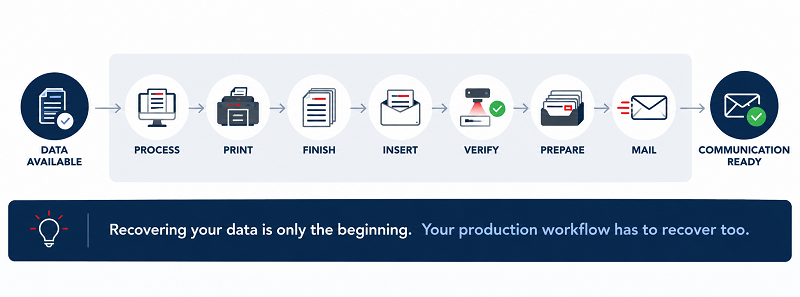
If your backup strategy restores your files but leaves you without production capacity, you may have recovered your data without actually recovering your operation.
For insurance providers, a true business continuity plan should address both.
Why Disaster Recovery Matters for Insurance Mail
Insurance communications frequently operate within strict timelines.
Depending on the document and applicable requirements, missing a mailing deadline can create compliance concerns, additional administrative work, and potential exposure.
That makes continuity particularly important for communications such as:
- Cancellation and nonrenewal notices
- Policy documents
- Billing notices
- Claims correspondence
- Regulatory communications
- Renewal notices
- Other time-sensitive policyholder mail
When a primary production location goes offline, the objective shouldn’t be to figure out a backup process from scratch.
The backup process should already exist.
The Problem With “Emergency” Disaster Recovery
One of the biggest weaknesses in traditional disaster recovery arrangements is that they aren’t part of everyday operations.
A secondary vendor or facility may technically be available, but hasn’t processed your files recently.
When a disruption occurs, teams suddenly need to determine:
- Can the backup facility process the current files?
- Are the latest templates available?
- Is the necessary inventory in place?
- Are data and production requirements current?
- Can the equipment support the work?
- How quickly can production actually begin?
An emergency is a bad time to discover the answers.
Disaster recovery works best when readiness is maintained before the disaster occurs.
What Should Insurers Look for in a Print & Mail DR Plan?
A strong disaster recovery program should be more than a sentence in a vendor’s business continuity document.
Geographic Redundancy
If both your primary and backup operations can be affected by the same regional event, your redundancy may not provide much protection.
Geographically separated production facilities help reduce dependence on a single region.
Current Data and Files
Your backup environment should have access to the information necessary to reproduce critical jobs.
A disaster recovery plan built around outdated files creates another potential point of failure.
Compatible Production Capabilities
A second location isn’t particularly useful if it cannot actually produce the same work.
Equipment, workflow, applications, and production capabilities should be considered as part of the DR strategy.
Defined Activation Procedures
Who makes the decision to move production? How are files transferred? Which jobs take priority? How quickly can production begin?
These decisions should be established before an outage occurs.
Testing
A plan that has never been tested is still largely theoretical.
Regular testing helps identify problems while there is still time to correct them.
Why Daily Disaster Recovery Changes the Equation
Instead of treating disaster recovery as something activated only after a major event, EOS offers a Daily Disaster Recovery approach.
The goal is to keep the secondary production environment prepared so critical work can be shifted when needed without building the process from scratch during an emergency.
That creates a fundamentally different approach to continuity.
Rather than asking:
“How do we recover this job?”
The question becomes:
“Where should we produce it today?”
For high-volume insurance communications, that distinction can be significant.
California + Texas Production
EOS operates production capabilities in California and Texas, providing geographic separation between facilities.
This multi-location model can help insurers reduce their dependence on a single production site or region.
If an event affects one location, production can be supported through another facility as part of the disaster recovery strategy.
That redundancy can be especially valuable during regional disruptions such as severe weather, power interruptions, or other unexpected events.
And because EOS works with regulated, time-sensitive communications, the objective isn’t simply getting production running again.
It’s keeping critical mail moving.
Don’t Wait for a Disaster to Test Your Plan
One of the best times to evaluate your print and mail disaster recovery strategy is when everything is operating normally.
Ask your current provider:
- Where will our work be produced if your primary facility goes down?
- How geographically separated is the backup location?
- How current are our data, applications, and templates at that facility?
- How quickly can production move?
- When was the process last tested?
- Can the secondary facility handle our actual production volume?
- What happens to time-sensitive compliance mail during the transition?
If those questions don’t have clear answers, your disaster recovery plan may deserve another look.
Disaster Recovery Is Really About Continuity
The best disaster recovery plan is one your policyholders never notice.
- Statements still arrive.
- Notices still go out.
- Deadlines are still met.
- Your team doesn’t need to scramble to establish a new production workflow in the middle of an emergency.
That’s ultimately what business continuity should provide.
Not simply a backup.
Confidence that critical communications can keep moving when something unexpected happens.
Build Resilience Into Your Print & Mail Operation
Insurance providers spend significant time protecting against risk. Your print and mail operation should be treated the same way.
EOS’s multi-location production capabilities in California and Texas, combined with our Daily Disaster Recovery approach, are designed to provide insurers with an additional layer of operational resilience for critical communications.
Because when a mailing deadline matters, your disaster recovery plan shouldn’t begin with figuring out what to do next.
It should already be ready.