Insurance operating costs are rising, and not just at the margins. Even before recent inflationary pressure, McKinsey found that many insurers experienced up to a 20% increase in support-function cost ratios between 2015 and 2019. Since then, high inflation, rising claims expenses, and expanding regulatory demands have only pushed operating costs higher, often forcing insurers to raise premiums simply to maintain profitability.
But increasing premiums is not a sustainable long-term strategy. The fastest path to structural savings comes from reducing avoidable overhead, especially within fragmented print-and-mail operations, which remain one of the most under-optimized cost centers in the industry.
Insurance executives are under pressure to reduce costs while protecting regulatory obligations, improving customer communications, and modernizing legacy operations. Print and mail is one of the most overlooked areas of potential savings.
Cost Pressures Are Rising and Insurance Leaders Need Stronger Control
As operating costs climb across the insurance sector, the bottlenecks inside print-and-mail operations amplify the problem. Rising postage costs, manual handling, and outdated vendor processes make it difficult for insurers to maintain control over budgets, timelines, or compliance.
Hidden Inefficiencies Are Driving Up Print-and-Mail Spend
In most organizations, the true cost of print and mail extends far beyond paper and postage. It often includes:
- Manual labor and staffing
- Reprints and production errors
- Exceptions handling
- Compliance checks
- Returned mail workflows
- Vendor fees and slip-ups
- Risk of missing regulatory deadlines
When these tasks rely on outdated technology or fragmented vendors, the hidden costs compound quickly.
Why Modernization Matters
Structured modernization allows insurance providers to streamline workflows without disrupting policy or claims operations. Executives who want predictable budgets, secure processes, and consistent customer communication need deeper visibility into their document lifecycle. Modern tools deliver that visibility—while converting scattered tasks into a coordinated, scalable, cost-controlled system.
Proven Strategies That Deliver Cost Savings and Stronger Compliance
Insurance communications come with strict regulatory expectations. Whether sending cancellation notices, billing statements, policy updates, or claim letters, every document must be delivered accurately, on time, and with a complete audit trail.
Below are the modernization strategies that consistently reduce costs and improve compliance for insurers of all sizes.
1. Electronic Proof of Mailing: Compliance Without the Manual Work
Many insurers still use manual or paper-based proof-of-mailing processes for notices of cancellation or nonrenewal. These workflows are slow, error-prone, and difficult to track during audits.
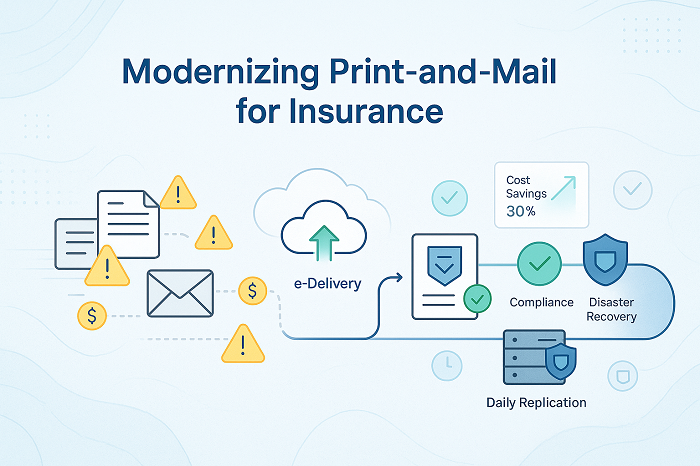
Shifting to electronic proof of mailing (ePOM) delivers immediate value:
- A complete digital audit trail
- Accurate timestamped records
- Faster verification for regulatory reviews
- Lower labor requirements
- Fewer documentation errors
Regulators increasingly expect clean, digitally accessible records. A certified ePOM system supports compliance while reducing workload and risk.
2. Mail Piece Optimization: Reduce Postage by Up to $1.20 per Envelope
Flat envelopes represent one of the biggest areas of unnecessary postage spending. In many cases, insurance providers use flats for convenience—not because the content requires it.
By restructuring documents into optimized letter-sized mail pieces, insurers can lower postage by up to $1.20 per envelope.
Additional benefits include:
- Reduced material costs
- Better sorting and faster delivery
- Fewer handling issues
- A smaller environmental footprint
For providers sending high-volume transactional mail, this optimization alone can deliver significant annual savings.
3. Migration to Secure eDelivery: Faster, Cheaper, and Customer-Friendly
Not every document needs to be mailed. Many policyholders prefer electronic communications—when delivered through secure, compliant systems.
Certified, PII-compliant eDelivery tools help insurers:
- Reduce paper and postage expenses
- Deliver documents in minutes instead of days
- Improve customer satisfaction
- Track delivery receipts and opens
- Automated hard bounce to USPS mail processes
- A hybrid model—mail for regulated notices, eDelivery for everything else—is both cost-effective and scalable.
4. Real-Time Visibility and Audit Control: Confidence Across Every Document
Insurance executives need assurance that every communication is handled correctly. Modern policy related document production and delivery systems offer:
- Real-time tracking across the entire document lifecycle
- Consistent quality checks
- Digital certificate proof of mailing documents
- Detailed reporting dashboards
This visibility helps leaders eliminate guesswork and avoid compliance risks before they escalate.
5. Built-In Disaster Recovery: Continuity Without Extra Infrastructure or cost
Disaster recovery is essential in insurance. Regional outages, system failures, and severe weather can halt production without warning.
A strong disaster recovery plan should provide:
- Daily file replication
- Secure off-site production
- Rapid activation
- Predictable cost structure
EOS offers a cost-neutral Daily Disaster Recovery solution for insurance providers who want continuity without building new internal infrastructure.
Why Insurance Executives Trust These Modernization Strategies
Insurance leaders are looking for more than lower operating costs. They want:
- Systems that reduce manual work
- Faster turnaround times
- Fewer errors and reprints
- A stronger compliance posture
- Better visibility into spend
- More reliable customer communications
- Workflows that scale with growth
Modern policy document production environments deliver all of this. These strategies are not quick fixes—they create long-term operational stability while strengthening compliance and financial performance.
EOS helps insurance companies achieve these outcomes through certified, SOC2 production environments, responsive support, and innovative tools that simplify every stage of the document lifecycle.
Start Reducing Operating Costs Today
If you want stronger control of your print-and-mail operations, now is the right time to begin. A structured review of your workflows—ePOM, mail piece optimization, eDelivery adoption, disaster recovery readiness, and vendor performance—will reveal clear opportunities to reduce costs and strengthen compliance.
For insurers that need business continuity without expanding internal infrastructure, ask us about our cost-neutral Daily Disaster Recovery service, designed specifically for regulated, high-volume insurance environments.
Contact EOS at 760-599-9945 to schedule a no-cost consultation and explore how modernization can improve stability, visibility, and long-term financial efficiency.